The Chinese calendar is a lunisolar calendar. Each month starts on the day of a new moon and lasts 29 or 30 days, and an extra leap month is added about seven times every 19 years to keep the calendar in step with the seasons. Chinese New Year, the first day of the first month, always falls between January 21 and February 20. In 2026 it fell on Tuesday, February 17, starting the Year of the Horse.
For more detail on the astronomy, see the Chinese calendar article.
How the months work
Twelve lunar months add up to about 354 days, roughly 11 days short of a solar year. Without a correction, Chinese New Year would drift through the seasons the way the Islamic calendar does. The fix is a 13th month in some years:
- A common year has 12 months and 353 to 355 days.
- A leap year has 13 months and 383 to 385 days.
- The leap month repeats the month before it. 2025 had a second 6th month, and 2028 will have a second 5th month.
Which month gets doubled depends on the sun. The calendar tracks 24 solar terms, points spaced 15 degrees apart along the sun's path. Twelve of them are major terms. A lunar month that contains no major term becomes the leap month. Month boundaries are calculated for Beijing time, which is why a new moon late in the evening in Europe can start a Chinese month on the following date.
Chinese New Year dates
| Year | Chinese New Year | Zodiac year |
|---|---|---|
| 2026 | Tuesday, February 17 | Fire Horse |
| 2027 | Saturday, February 6 | Fire Goat |
| 2028 | Wednesday, January 26 | Earth Monkey |
| 2029 | Tuesday, February 13 | Earth Rooster |
| 2030 | Sunday, February 3 | Metal Dog |
Chinese New Year usually falls on the second new moon after the winter solstice. The Year of the Horse runs from February 17, 2026 to February 5, 2027.
The zodiac and the 60-year cycle
Years are named in a 60-year cycle that combines two sequences:
- 12 animals: Rat, Ox, Tiger, Rabbit, Dragon, Snake, Horse, Goat, Monkey, Rooster, Dog, Pig.
- 10 heavenly stems, which pair with five elements (Wood, Fire, Earth, Metal, Water), each element covering two consecutive years.
Because 10 and 12 share a factor of 2, the combinations repeat every 60 years, not 120. 2026 is a bingwu year, Fire Horse, and the previous Fire Horse year was 1966. Note that the animal changes at Chinese New Year, not on January 1, so someone born in January 2026 was born in the Year of the Snake.
Traditional festivals in 2026
Festivals follow the lunar date, so their Gregorian dates move each year:
| Festival | Lunar date | 2026 date |
|---|---|---|
| Chinese New Year (Spring Festival) | 1st month, day 1 | February 17 |
| Lantern Festival | 1st month, day 15 | March 3 |
| Dragon Boat Festival | 5th month, day 5 | June 19 |
| Mid-Autumn Festival | 8th month, day 15 | September 25 |
| Double Ninth Festival | 9th month, day 9 | October 18 |
Qingming, the tomb-sweeping festival, is the exception: it is a solar term, so it falls on April 4 or 5 in current years.
Where the calendar is used
China, Taiwan, Hong Kong and Singapore use the Gregorian calendar for civil dates and the Chinese calendar for festivals, public holidays and traditional dates such as weddings. Korea's Seollal and Vietnam's Tết are based on closely related lunisolar calendars, and usually fall on the same day as Chinese New Year, though Vietnam calculates on its own time zone and occasionally differs.
Planning around it
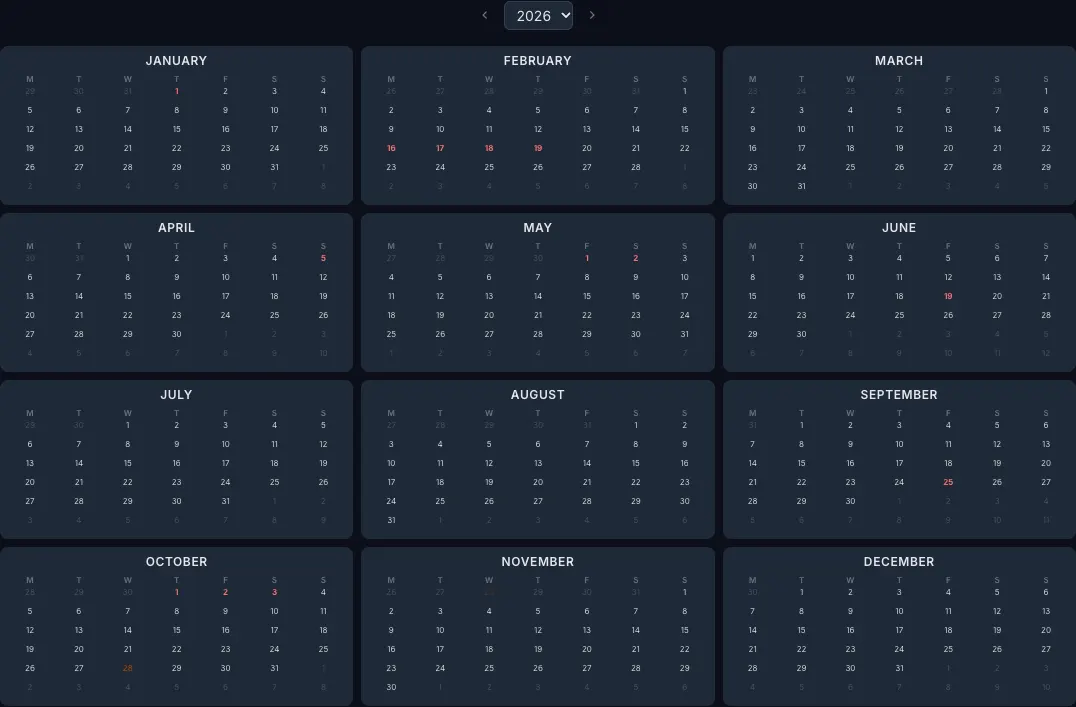
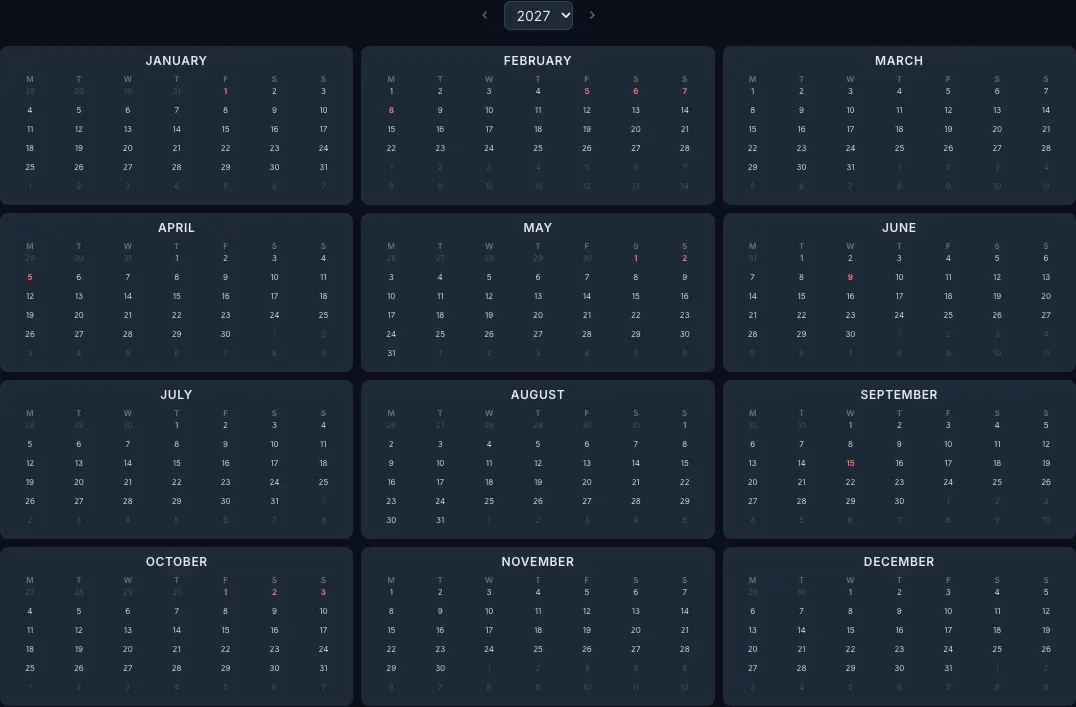
Chinese New Year holidays shift by up to a month from one year to the next, which matters for travel, manufacturing schedules and shipping. The China holidays 2026 and China holidays 2027 pages list the official days off, and the 2027 calendar shows where February 6 falls in the week. For another calendar that runs on the moon, read the Islamic Hijri calendar, and for how the Western calendar reached its current form, Julian vs Gregorian calendar.
Frequently asked questions
Saturday, February 6, 2027. It starts the Year of the Goat (Fire Goat).
Both. It is lunisolar: months follow the moon, and a leap month is added about seven times every 19 years to keep the year aligned with the sun.
It falls on the new moon that starts the first lunar month, usually the second new moon after the winter solstice, so its Gregorian date moves between January 21 and February 20.