A year has 52 weeks and 1 day. A common year is 365 days and 52 × 7 = 364, so one day is left over. A leap year has 366 days, which makes it 52 weeks and 2 days. Averaged over the Gregorian calendar's 400-year cycle, a year lasts 365.2425 days, or about 52.18 weeks.
What the leftover day does
The extra day is why your birthday moves forward one weekday each year, and two weekdays when a February 29 falls in between. It also means one weekday occurs 53 times in a common year: the weekday of January 1. In a leap year, the weekdays of both January 1 and January 2 occur 53 times.
January 1, 2026 is a Thursday, so 2026 has 53 Thursdays and 52 of every other weekday. That has practical consequences:
- If you are paid weekly on the day that gets a 53rd occurrence, you receive 53 paychecks that year instead of 52.
- A biweekly schedule produces 27 paydays instead of 26 when the first payday lands on January 1 (or January 1 or 2 in a leap year). For any given biweekly schedule that happens roughly once every 11 years.
- Weekly subscriptions, rent paid by the week and recurring weekly meetings all have one extra instance in those years.
Calendar weeks vs ISO week numbers
Counting days gives 52 weeks and change. Counting numbered weeks is a different question, because the week that straddles New Year has to belong to one year or the other.
The numbering scheme is defined in ISO 8601; the ISO week date entry summarizes the rules.
ISO 8601, the international standard used across Europe and in most business and planning software, settles it like this:
- Weeks start on Monday.
- Week 1 is the week that contains the year's first Thursday. Put another way, it is the week that contains January 4.
- Every week belongs entirely to one ISO year, so the first days of January can belong to the last week of the previous year, and the last days of December can belong to week 1 of the next.
Under that rule a year has either 52 or 53 numbered weeks. It has 53 when January 1 is a Thursday, or when a leap year starts on a Wednesday. That happens 71 times in every 400 years, roughly every five or six years. The recent and upcoming 53-week years are 2020, 2026, 2032, 2037, 2043 and 2048.
Many US wall calendars and spreadsheet defaults use a different system: weeks start on Sunday and week 1 is whichever week contains January 1. Under that system December 31 always lands in week 53, and in a leap year that starts on a Saturday, such as 2028, it lands in week 54. In Excel, WEEKNUM uses the Sunday system by default and ISOWEEKNUM returns the ISO number, which is why two people can quote different week numbers for the same date.
Weeks per year, 2024 to 2032
| Year | Days | Starts on | Ends on | Weekdays that occur 53 times | ISO weeks |
|---|---|---|---|---|---|
| 2024 | 366 | Monday | Tuesday | Monday, Tuesday | 52 |
| 2025 | 365 | Wednesday | Wednesday | Wednesday | 52 |
| 2026 | 365 | Thursday | Thursday | Thursday | 53 |
| 2027 | 365 | Friday | Friday | Friday | 52 |
| 2028 | 366 | Saturday | Sunday | Saturday, Sunday | 52 |
| 2029 | 365 | Monday | Monday | Monday | 52 |
| 2030 | 365 | Tuesday | Tuesday | Tuesday | 52 |
| 2031 | 365 | Wednesday | Wednesday | Wednesday | 52 |
| 2032 | 366 | Thursday | Friday | Thursday, Friday | 53 |
Notice that 2032 is a leap year starting on a Thursday, so it qualifies for 53 ISO weeks on the first rule alone. 2028 is a leap year too, but it starts on a Saturday, so it stays at 52.
How many weeks are in a month
Every month has four full weeks plus zero to three days:
- 28 days (February in a common year): exactly 4 weeks
- 29 days (February in a leap year): 4 weeks and 1 day
- 30 days: 4 weeks and 2 days
- 31 days: 4 weeks and 3 days
The average month is 30.44 days, or about 4.35 weeks. Payroll and budgeting often use 52 ÷ 12 = 4.33 weeks per month when converting weekly amounts to monthly ones, which slightly undercounts because it ignores the leftover day.
Working weeks
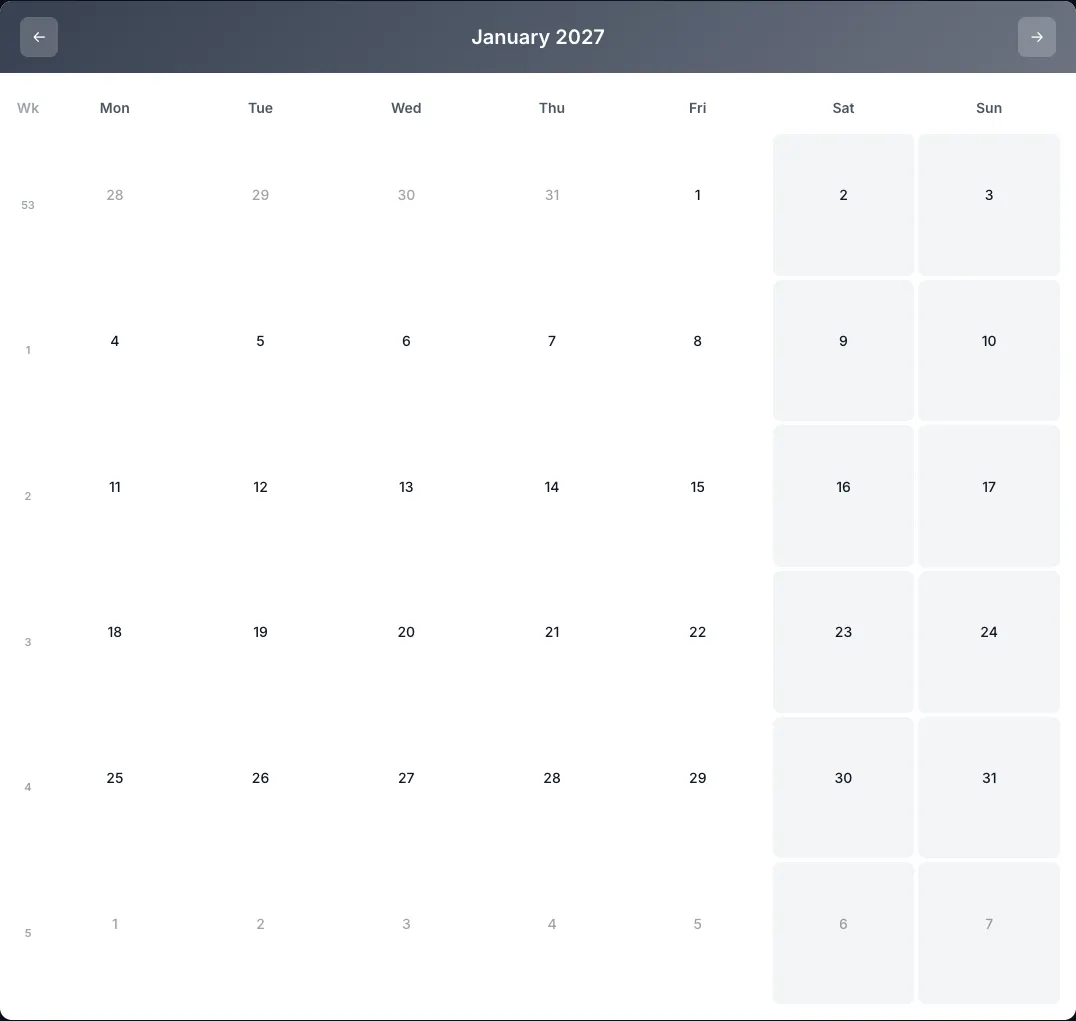
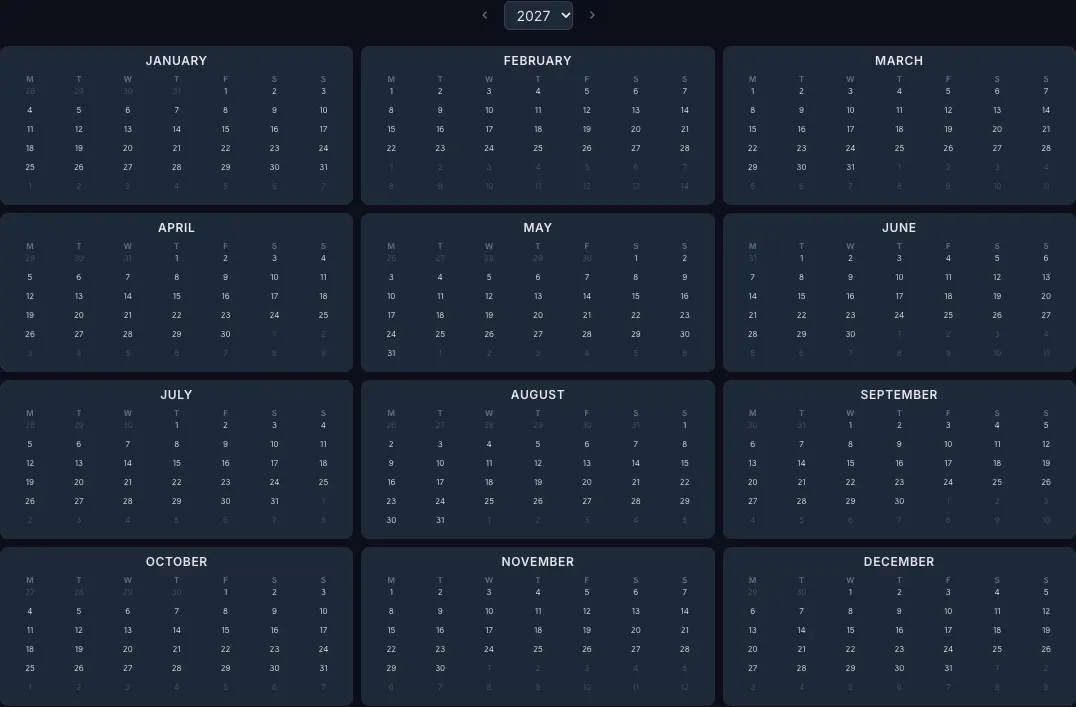
Taking out weekends, 2026 and 2027 each have 261 weekdays (Monday to Friday), and 2028 has 260. Public holidays reduce that further. The 2026 calendar lists working days and ISO week numbers month by month, and the 2027 calendar does the same for next year.
If you plan in weeks rather than months, a week-per-page layout from the weekly templates keeps the week numbers in front of you. For the full breakdown of the current year, see how many weeks are in 2026, and for the leap-year side of the count, is 2028 a leap year.
Frequently asked questions
A common year has 52 weeks and 1 day (365 days). A leap year has 52 weeks and 2 days (366 days).
Yes, by ISO 8601 week numbering. A year has 53 ISO weeks when January 1 is a Thursday, or when a leap year starts on a Wednesday. 2020, 2026 and 2032 are 53-week years.
A leap year has 366 days, which is 52 weeks and 2 days. The weekdays of January 1 and January 2 each occur 53 times.