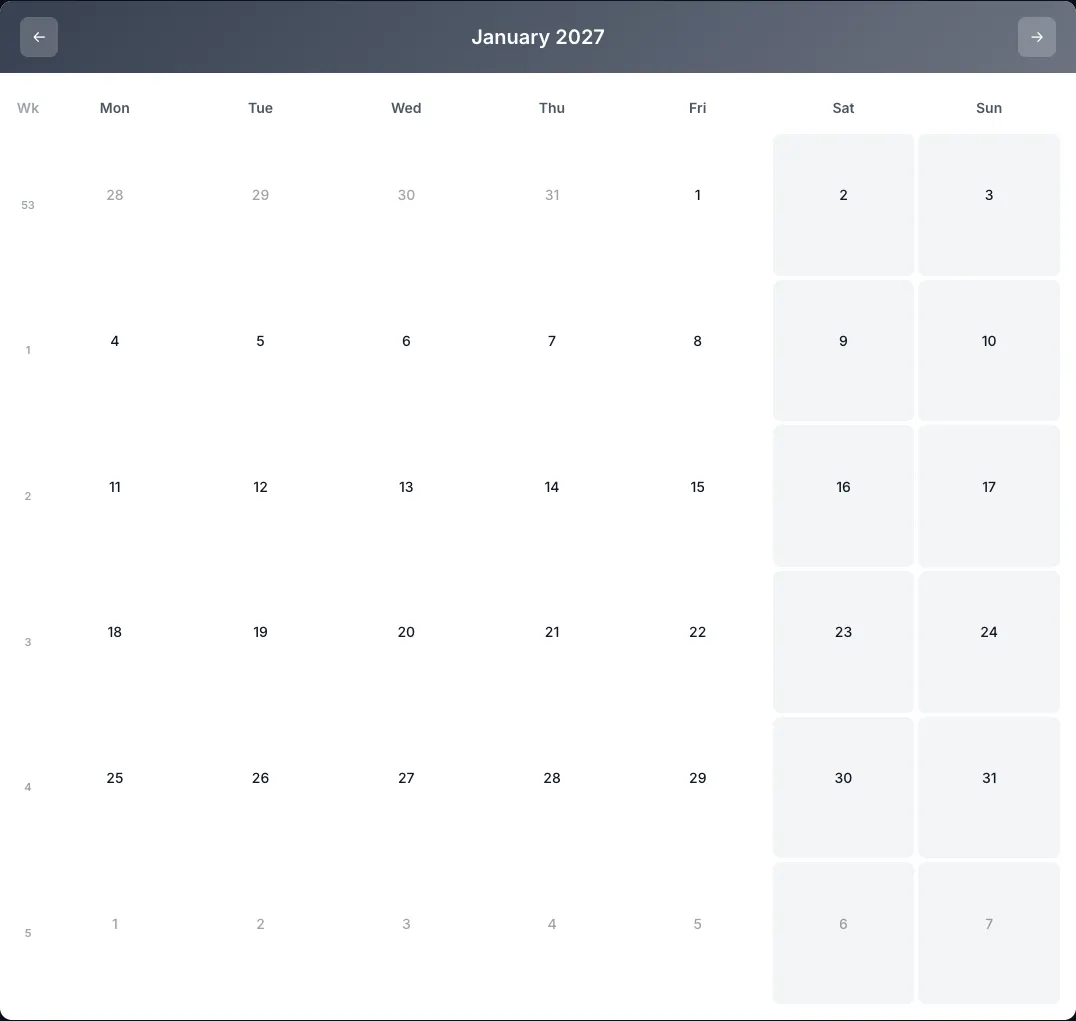
2026 has 52 weeks and 1 day. It is a common year of 365 days, and the extra day is a Thursday, because the year starts and ends on a Thursday. Under ISO 8601 week numbering, 2026 has 53 weeks: week 1 starts on Monday, December 29, 2025, and week 53 ends on Sunday, January 3, 2027.
Week numbering follows ISO 8601, summarized in the ISO week date entry.
Why 2026 gets a week 53
An ISO year has 53 weeks whenever January 1 falls on a Thursday. The rule exists because week 1 is defined as the week containing the year's first Thursday. In 2026, January 1 itself is that Thursday, so the week of December 29, 2025 to January 4, 2026 counts as week 1 of 2026. At the other end, December 31, 2026 is also a Thursday, so the week of December 28, 2026 to January 3, 2027 still belongs to 2026 and becomes week 53.
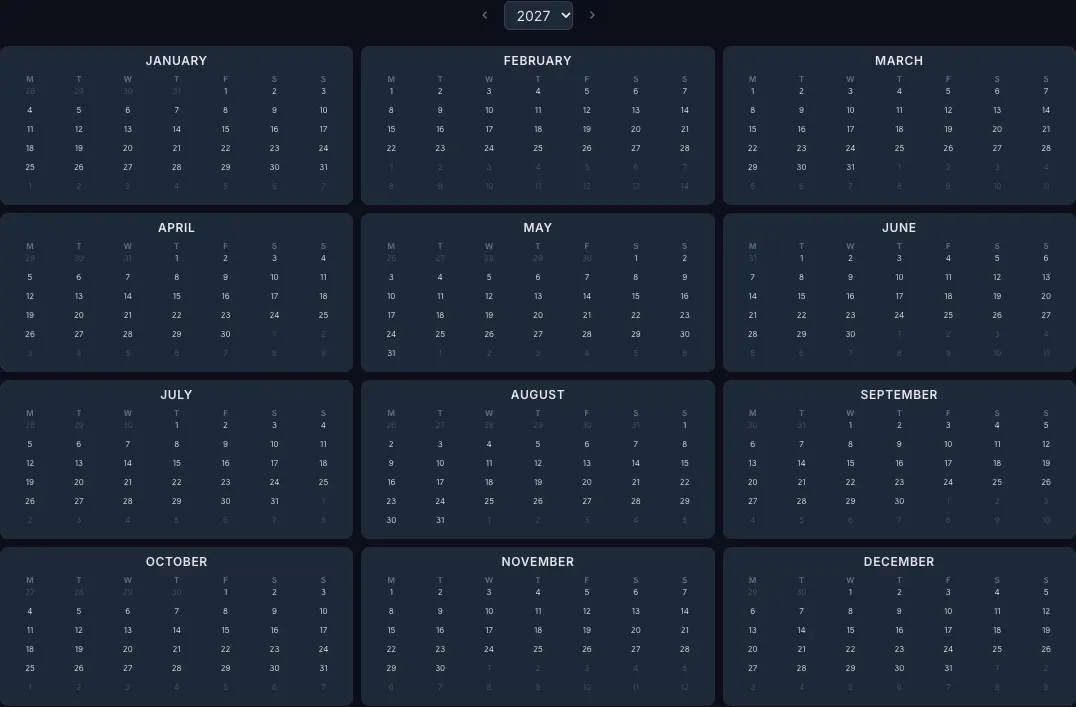
The last 53-week year was 2020. The next one after 2026 is 2032. 2027 has the usual 52 weeks, with week 1 starting on Monday, January 4, 2027.
2026 at a glance
| Fact | 2026 |
|---|---|
| Days | 365 (not a leap year) |
| Weeks and days | 52 weeks + 1 day |
| ISO weeks | 53 |
| First day | Thursday, January 1 |
| Last day | Thursday, December 31 |
| Weekday that occurs 53 times | Thursday |
| Weekdays (Monday to Friday) | 261 |
| Weekdays minus the 11 US federal holidays | 250 |
All eleven US federal holidays in 2026 are observed on a weekday. Independence Day falls on a Saturday, so federal employees get Friday, July 3 off instead. The full list with observed dates is on the US holidays 2026 page.
Weeks and working days by month
| Month | Days | Weekdays | ISO weeks |
|---|---|---|---|
| January | 31 | 22 | 1 to 5 |
| February | 28 | 20 | 5 to 9 |
| March | 31 | 22 | 9 to 14 |
| April | 30 | 22 | 14 to 18 |
| May | 31 | 21 | 18 to 22 |
| June | 30 | 22 | 23 to 27 |
| July | 31 | 23 | 27 to 31 |
| August | 31 | 21 | 31 to 36 |
| September | 30 | 22 | 36 to 40 |
| October | 31 | 22 | 40 to 44 |
| November | 30 | 21 | 44 to 49 |
| December | 31 | 23 | 49 to 53 |
Weekday counts are before public holidays. A month shares a week number with the previous month whenever it does not start on a Monday, which is why most ranges overlap by one.
What the 53rd Thursday changes
The extra Thursday is the only thing that makes 2026 longer than 52 whole weeks, and it shows up in pay schedules:
- Weekly pay on Thursdays means 53 paydays in 2026.
- Biweekly pay on Thursdays that starts on January 1 gives 27 paydays. Biweekly schedules that pay on other Thursdays or on Fridays give 26.
- Any budget built on "52 weekly payments" is one payment short for Thursday schedules.
How 2026 compares with nearby years
| Year | Days | ISO weeks | Extra weekday |
|---|---|---|---|
| 2025 | 365 | 52 | Wednesday |
| 2026 | 365 | 53 | Thursday |
| 2027 | 365 | 52 | Friday |
| 2028 | 366 | 52 | Saturday and Sunday |
For the general rule and a table through 2032, read how many weeks are in a year.
Plan the year by week
The 2026 calendar shows every month with ISO week numbers, and each month page, starting with January 2026, lists its working days. If you are planning across the turn of the year, the 2026 to 2027 calendar puts both years side by side. To print a week-by-week planner, start from a weekly template and export it as a PDF.
Frequently asked questions
2026 has 52 weeks and 1 day (365 days). By ISO 8601 week numbering it has 53 weeks, because January 1, 2026 is a Thursday.
ISO week 1 of 2026 starts on Monday, December 29, 2025 and ends on Sunday, January 4, 2026.
ISO week 53 of 2026 runs from Monday, December 28, 2026 to Sunday, January 3, 2027.