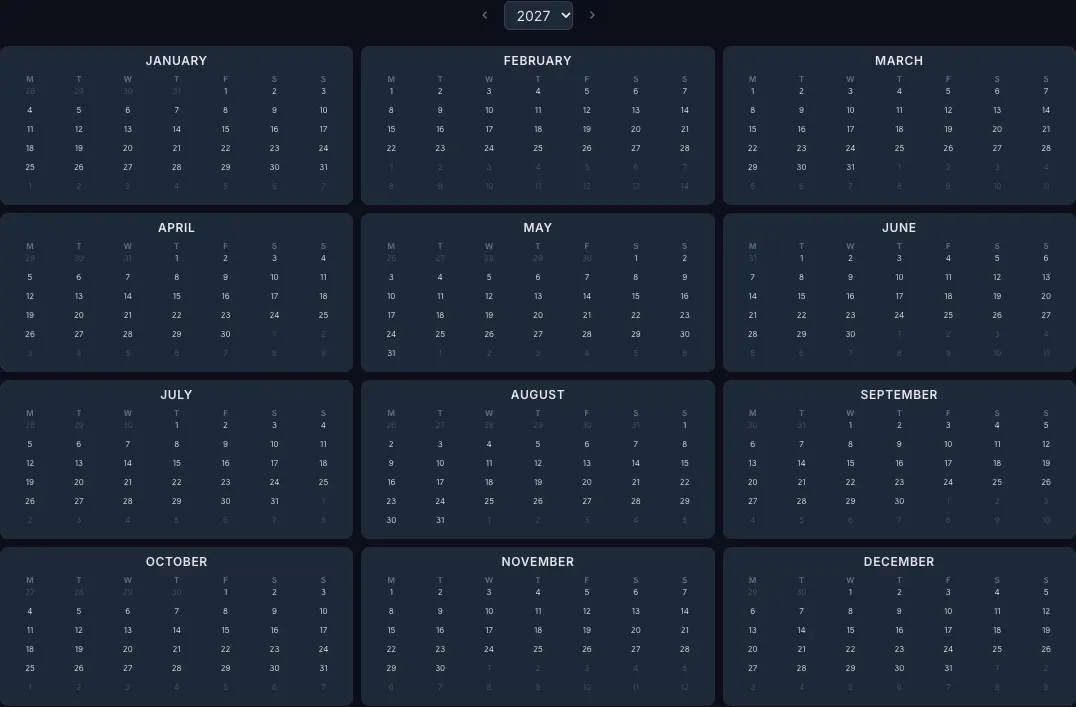
A perpetual calendar lets you find the day of the week for any date across many years. It works because there are only 14 possible year calendars: a year can start on any of the 7 weekdays, and it is either a common year or a leap year. 2026 is a common year starting on Thursday, so it has exactly the same calendar as 2015, 2037 and 2043. 2027 is a common year starting on Friday, the same as 2010, 2021 and 2038.

Years with the same calendar as 2026
2026 starts on a Thursday and has 365 days. Every common year that starts on a Thursday has identical dates and weekdays:
| Before 2026 | After 2026 |
|---|---|
| 1998 | 2037 |
| 2009 | 2043 |
| 2015 | 2054 |
| 2065 | |
| 2071 |
Even Easter matches in this group: it fell on April 5 in 2015, and it falls on April 5 in 2026 and again in 2037. That is a coincidence of the lunar cycle, not a rule, so check moving holidays separately when you reuse an old calendar.
Years with the same calendar as 2027
2027 starts on a Friday and has 365 days:
| Before 2027 | After 2027 |
|---|---|
| 1993 | 2038 |
| 1999 | 2049 |
| 2010 | 2055 |
| 2021 | 2066 |
| 2077 |
So a 2021 calendar lines up day for day with 2027. Holidays tied to a weekday, such as Thanksgiving or Memorial Day, land on the same dates. Easter does not: it was April 4 in 2021 and is March 28 in 2027.
How often calendars repeat
- Common years repeat after 6, 11 or 11 years in a repeating order: 2015, 2026, 2037, 2043, 2054. The pattern holds as long as no skipped century leap year intervenes.
- Leap years repeat every 28 years. 2028 starts on a Saturday, like 2000 and 2056.
- The whole Gregorian calendar repeats every 400 years exactly. Those 400 years contain 97 leap days, for 146,097 days, which is precisely 20,871 weeks. 2426 will look exactly like 2026.
The 28-year leap cycle breaks around century years that skip their leap day. 2100 is not a leap year, so it starts on a Friday with 365 days and shares its calendar with 2027.
How a printed perpetual calendar works
The classic printed version has two parts:
- A lookup table of years, each mapped to a number or letter from 1 to 14.
- Fourteen small year calendars, one per number.
Printed and mechanical designs are described in the perpetual calendar article.
Find your year in the table, turn to the matching calendar, and read the weekday for any date. Desk versions do the same thing with rotating dials or movable blocks for month and day.
Finding a weekday in your head
The doomsday rule, worked out by the mathematician John Conway, gets you the weekday without a table. In any year, a set of easy dates all fall on the same weekday, called the year's doomsday:
- 4/4, 6/6, 8/8, 10/10 and 12/12
- 5/9 and 9/5, 7/11 and 11/7
- March 14, which is the same weekday as the last day of February
In 2026 those dates are all Saturdays. To find the weekday of July 4, 2026, start from 7/11 (a Saturday) and count back seven days: July 4 is also a Saturday. In 2027 the doomsday is Sunday, and in 2028 it is Tuesday.
Reusing an old calendar
If you have a printed 2015 calendar you liked, it will work for 2026 once you correct holidays that move by date rather than weekday rule. The easier option is to print the right year: the 2026 calendar and 2027 calendar are ready to print, and the yearly templates let you style a full year and export it as a PDF. For the leap year side of the cycle, see is 2028 a leap year, and for the week counts behind all of this, how many weeks are in a year.
Frequently asked questions
2015 has the same calendar as 2026, as do 1998, 2009, 2037, 2043 and 2054. All are common years starting on a Thursday.
2021 has the same calendar as 2027, as do 1993, 1999, 2010, 2038 and 2049. All are common years starting on a Friday.
Fourteen: seven possible starting weekdays, each in a common-year and a leap-year version.