The Islamic calendar, also called the Hijri calendar, is purely lunar. It has 12 months of 29 or 30 days, for a year of 354 or 355 days, about 11 days shorter than a solar year. Years are counted from the Hijra, the Prophet Muhammad's migration from Mecca to Medina in 622 CE, and are marked AH (anno Hegirae). The current year, 1448 AH, began in mid-June 2026.
For more background, see the Islamic calendar article.
How the months start
Each month begins when the new crescent moon is first seen after sunset. A month therefore has 29 or 30 days, and the day itself begins at sunset rather than midnight.
Countries handle the start of a month in different ways:
- By local sighting. Many communities wait for the crescent to be seen locally or in a nearby country, so a month can start a day apart in different places.
- By calculation. Saudi Arabia's official Umm al-Qura calendar fixes months in advance from astronomical data, though the start of Ramadan and the two Eids is still confirmed by sighting. Turkey also uses a calculated calendar.
- By fixed arithmetic. The tabular Islamic calendar uses a 30-year cycle with 11 leap years of 355 days. It is used for conversions and software, not for religious dates.
Because of these differences, any Gregorian date given for an Islamic month is an expectation, and may move by a day.
The twelve months
- Muharram
- Safar
- Rabi al-Awwal
- Rabi al-Thani
- Jumada al-Ula
- Jumada al-Akhirah
- Rajab
- Shaban
- Ramadan
- Shawwal
- Dhu al-Qadah
- Dhu al-Hijjah
Four of them, Muharram, Rajab, Dhu al-Qadah and Dhu al-Hijjah, are sacred months in which fighting is traditionally forbidden. Ramadan is the month of fasting, and the Hajj pilgrimage takes place in Dhu al-Hijjah.
Why Ramadan moves through the seasons
The calendar has no leap month, so it is not tied to the sun. Every Islamic date arrives about 11 days earlier in the Gregorian calendar than it did the year before, and it takes about 33 years to cycle through all seasons. In the Northern Hemisphere, Ramadan fell in summer in the 2010s and is now moving into winter. In 2030 it is expected to start twice by the Gregorian calendar: around January 5 and again around December 26.
Key dates, 2026 to 2028
The 2026 dates are the ones Saudi Arabia announced. Later dates follow the Umm al-Qura calendar and may shift by a day depending on the moon sighting and your country.
| Event | 2026 | 2027 (expected) | 2028 (expected) |
|---|---|---|---|
| Ramadan begins | February 18 | February 8 | January 28 |
| Eid al-Fitr | March 20 | March 9 | February 26 |
| Day of Arafah | May 26 | May 15 | May 4 |
| Eid al-Adha | May 27 | May 16 | May 5 |
| Islamic New Year | June 16 (1448 AH) | June 6 (1449 AH) | May 25 (1450 AH) |
Observances begin at sunset on the evening before the date shown.
Converting years
A rough conversion from a Gregorian year to an Islamic one is AH = (CE − 622) × 33 ÷ 32. For 2026 that gives about 1448, which matches the Islamic year that began in June 2026. For an exact day-to-day conversion use a converter that states which method it follows, since sighted and calculated calendars can differ by a day.
Where it is used
The Hijri calendar sets religious dates for Muslims worldwide. Saudi Arabia also uses it for official dates, although in 2016 it moved public-sector pay to the Gregorian calendar. Most other Muslim-majority countries use the Gregorian calendar for civil purposes and the Hijri calendar for religious holidays.

Planning around Islamic dates
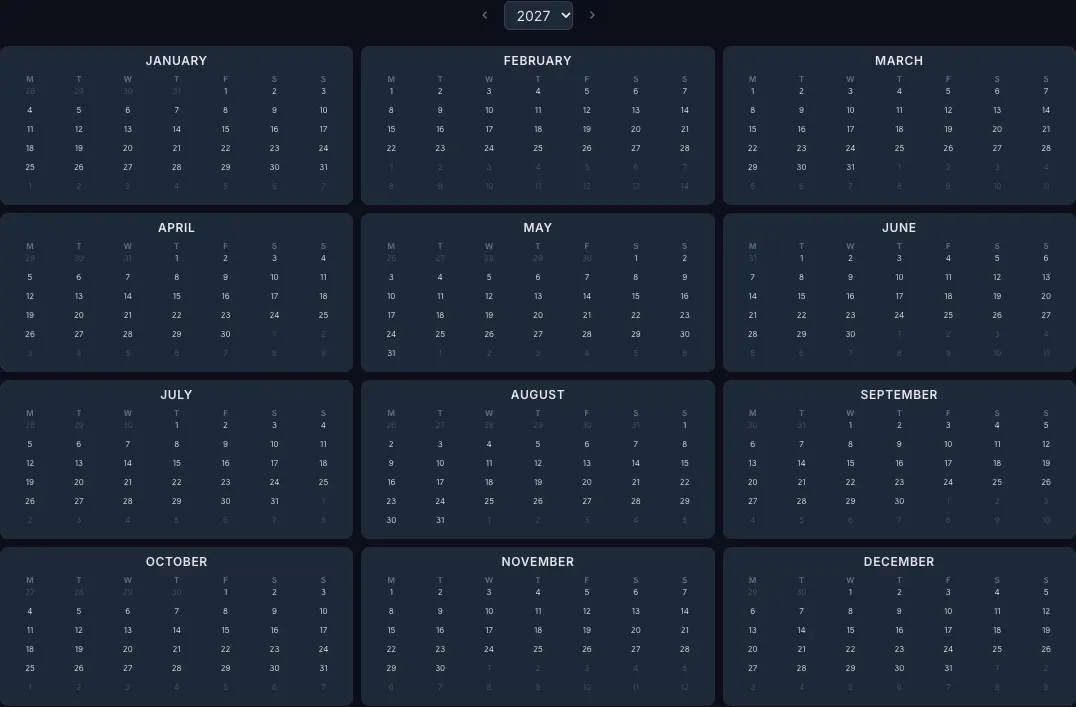
Because the dates move each year, it helps to mark them on a printed calendar once they are announced. The 2027 calendar and 2028 calendar show where each expected date falls in the week, and you can add them as events in the builder to export a PDF. For another calendar that follows the moon but adds leap months, read the Chinese calendar, and for the solar side, Julian vs Gregorian calendar.
Frequently asked questions
The Islamic year 1448 AH began in mid-June 2026 and runs until early June 2027, when 1449 AH begins.
354 or 355 days, in 12 lunar months of 29 or 30 days each.
Ramadan 2027 is expected to begin around February 8, 2027, with Eid al-Fitr around March 9. Exact dates depend on the moon sighting.